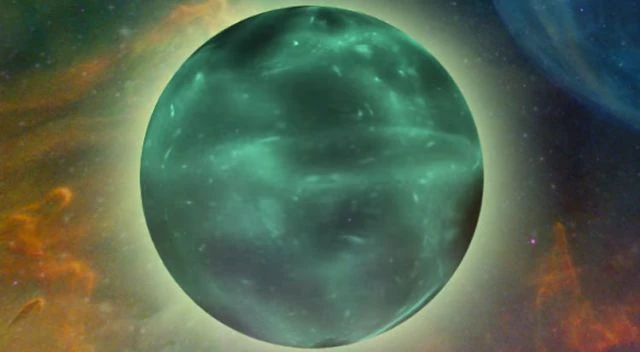
Quark stars
With the idea of neutron stars already introduced, where gravity is so intense that electrons and protons fuse to form neutrons, it seems natural to ask: What if we tried more pressure?
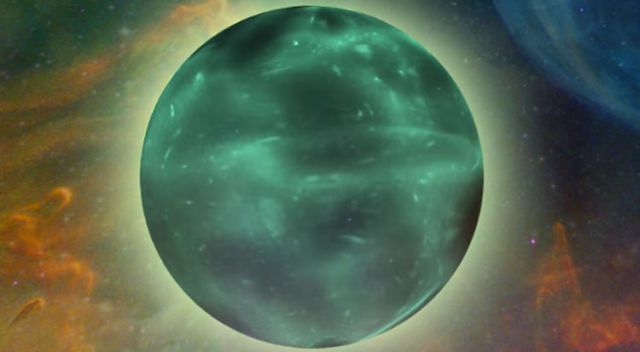
The answer is a quark star. Contrary to the name, quark stars are not necessarily stars per se; it is hypothesised that many quark "stars" actually exist in the cores of neutron stars. Simply put, quark stars are what happens when the pressures involved are so high that even neutrons are unstable, but not so high that the neutron star collapses into a black hole.
To explain what happens now, we must introduce the idea of quarks in the first place. Quarks are, simply put, the building blocks of hadrons, a category of particles that includes protons and neutrons. In protons and neutrons, quarks are "bound" together in trios, interacting through other particles called gluons. In a proton, the trio is of two "up" quarks and 1 "down" quark. In a neutron, it's of two down quarks and an up quark. But why does this matter?

It turns out that at high enough pressures, the degeneracy pressure of neutrons is overcome. Here, neutrons are forced to dissolve, forming a hyper-dense phase of degenerate matter, comprised of tightly-packed quarks. This is referred to as quark matter, and there are two main possible forms of "stable" quark matter.
The first is referred to as a quark-gluon plasma. In this plasma, free quarks swim around in a sea of gluons. So far, scientists have created quark-gluon plasmas at extreme temperatures (300,000 times hotter than the core of the Sun), and have already found that they exhibit surprising characteristics. For instance, rather than acting like particles in a gas, quark-gluon plasmas actually flow like liquids. Still, though, we have only been able to create these plasmas on very short timescales. Furthermore, we create these quark-gluon plasmas in particle accelerators. By contrast, the cores of neutron stars are at significantly lower temperatures, and much higher pressures. As such, we do not know if quark-gluon plasmas can actually form in the cores of neutron stars.
There is another form of "stable" quark matter, and here, things get a bit stranger.
References
- J. Letessier, J. Rafelski, Hadrons and quark-gluon plasma, Cambridge, Cambridge University Press, 2002.
- D. Blaschke, A. Sedrakian, N. K. Glendenning, Physics of neutron star interiors, Lecture Notes in Physics. Vol. 578. Springer-Verlag, 2002. doi: 10.1007/3-540-44578-1
- CERN: https://home.web.cern.ch/science/physics/standard-model
Images:
[1] https://static.wikia.nocookie.net/beyond-universe/images/e/e6/Qunium_Star.jpg/revision/latest?cb=20210719050635
[2] Wikipedia Commons, https://commons.wikimedia.org/wiki/File:Neutron_quark_structure.svg